
Easy Decision Maker
Some decisions deserve more than a coin toss, and some don’t. This decision maker handles both: a weighted decision matrix for important choices — jobs, apartments, schools, cars — that shows not just the winner but how close the call is, and a quick random picker for dinner-and-a-movie decisions. Everything stays on your device.
- Free to use
- No sign-up
- Runs in your browser
Easy decision maker
Small decision? Let chance pick
Decision Making Template Pack
Excel weighted decision matrix, printable pros and cons worksheet, 10/10/10 reflection sheet, decision checklist and a decision journal.
- Decision matrix (XLSX)
- Pros and cons (PDF/DOCX)
- 10/10/10 sheet (PDF/DOCX)
- Decision checklist (PDF/DOCX)
- Decision journal (PDF/DOCX/XLSX)
Formats: XLSX, PDF, DOCX. Instant download after payment (link valid 72 hours, up to 5 downloads). AI-assisted: the templates were drafted with AI help and reviewed and laid out before publishing.
$5.00 USD, one-time 5 files · about $1.00 each
- Instant download
- 7-day refund
- Secure checkout by Stripe
7-day money-back guarantee. Full refund within 7 days of purchase, even after you download.
Free sample: Decision Matrix (PDF, 59 KB)
Full refund within 7 days — see the refund policy and license.
Free printables
Single sheets you can print right now, no sign-up. The full pack adds every sheet in one download plus the editable files.
 Printable Weighted Decision Matrix
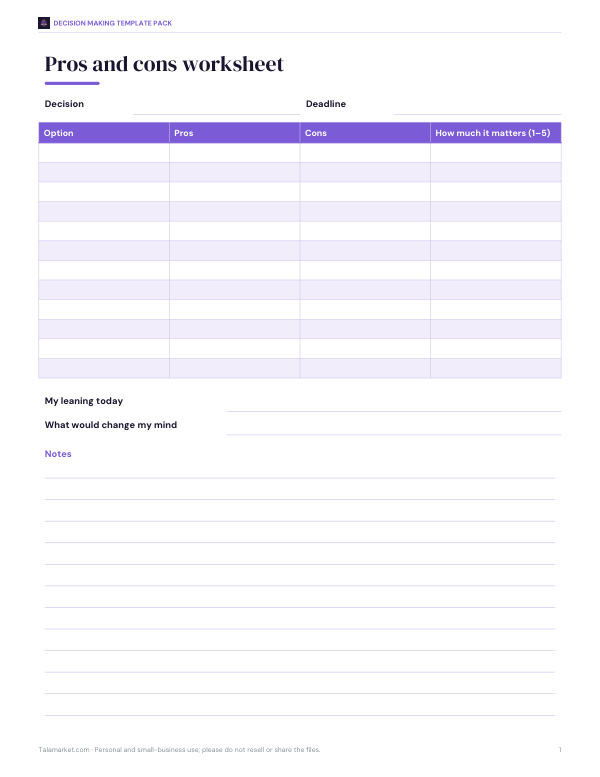 Printable Pros and Cons Worksheet
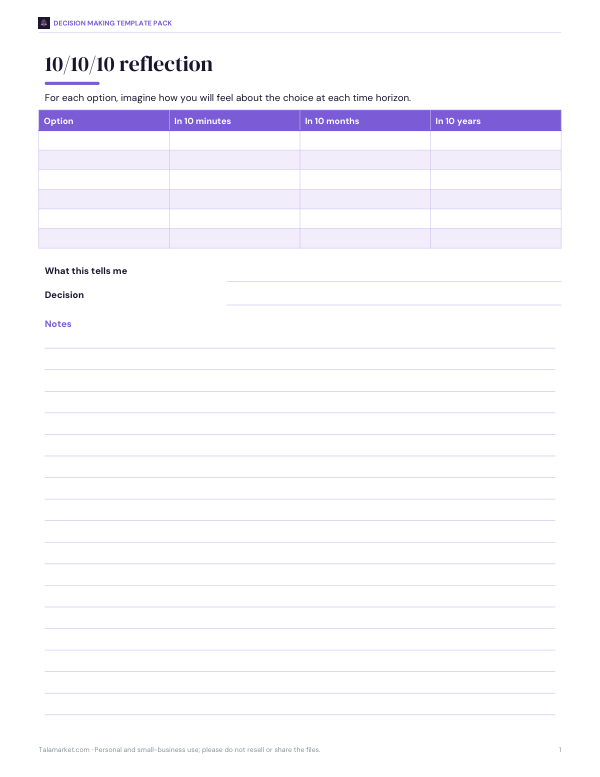 Printable 10/10/10 Decision Sheet
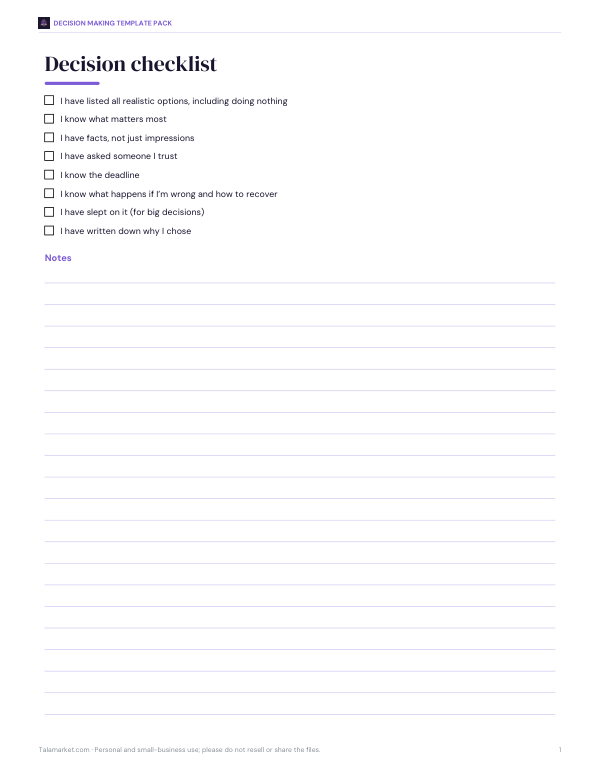 Printable Decision Checklist
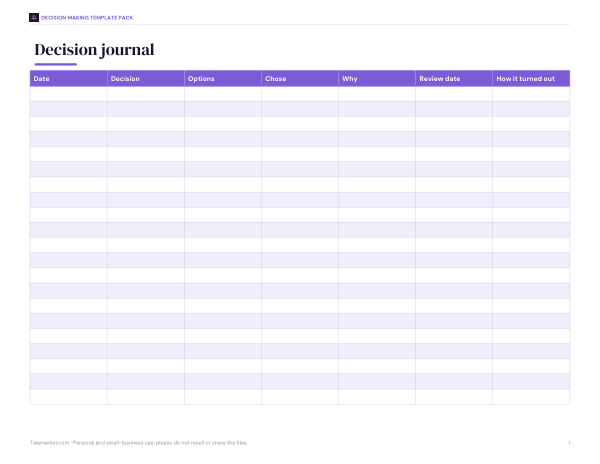 Printable Decision Journal
How the decision matrix works
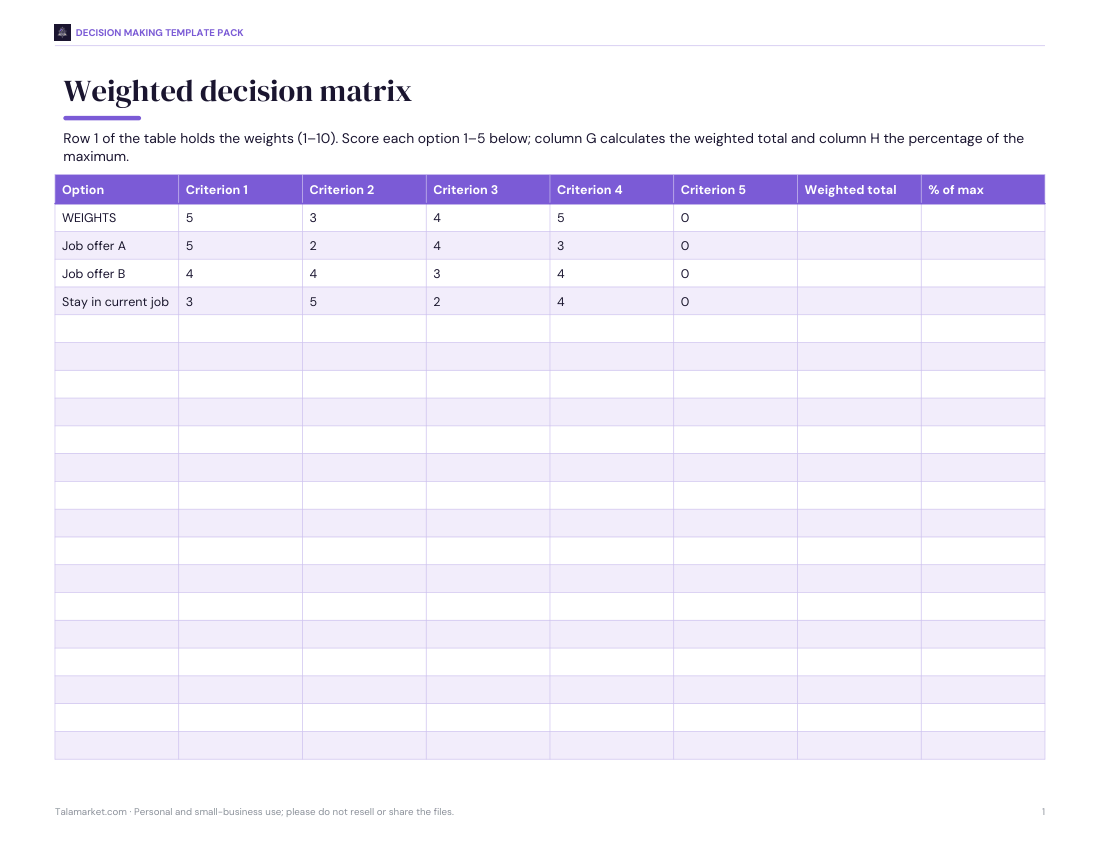
A weighted decision matrix — sometimes called a Pugh matrix or weighted scoring model — breaks a decision into the things that matter to you. Each criterion gets a weight for how important it is; each option gets a score for how well it does on that criterion. Multiplying and adding gives every option a total, so a choice that is excellent on what matters most beats one that is merely good at everything minor. The method is simple enough to do on paper, which is why it is widely taught in business, engineering and career guidance.
Step by step
- List the realistic options, including “do nothing” or “stay as is”.
- List what matters — 3 to 7 criteria is usually enough.
- Weight each criterion from 1 (nice to have) to 10 (essential).
- Score each option 1–5 on each criterion, one criterion at a time across all options.
- Read the ranking — and the sensitivity check — then ask whether the result feels right.
Worked example
Someone is choosing between Job offer A, Job offer B, Stay in current job. They weight salary 5, commute 3, growth 4, work-life balance 5, and score the options Job offer A 5/2/4/3, Job offer B 4/4/3/4, Stay in current job 3/5/2/4. The totals are Job offer A 62, Job offer B 64, Stay in current job 58 out of a possible 85. Job offer B leads, but only just, and the sensitivity check shows changing the commute weight from 3 to 2 produces a tie between Job offer A and Job offer B. That tells them the decision really hinges on how much the commute matters — worth thinking about before signing anything.
When the result feels wrong
If the matrix says one thing and your gut says another, that is useful information: it often means a criterion is missing (culture, a partner’s view, risk) or a weight is off. Adjust and look again, but be honest — tweaking numbers until your favourite wins defeats the purpose. The sensitivity check helps here: if a small, defensible change flips the result, the options are genuinely close and either is a reasonable choice.
Other simple decision methods
| Method | How it works | Good for |
|---|---|---|
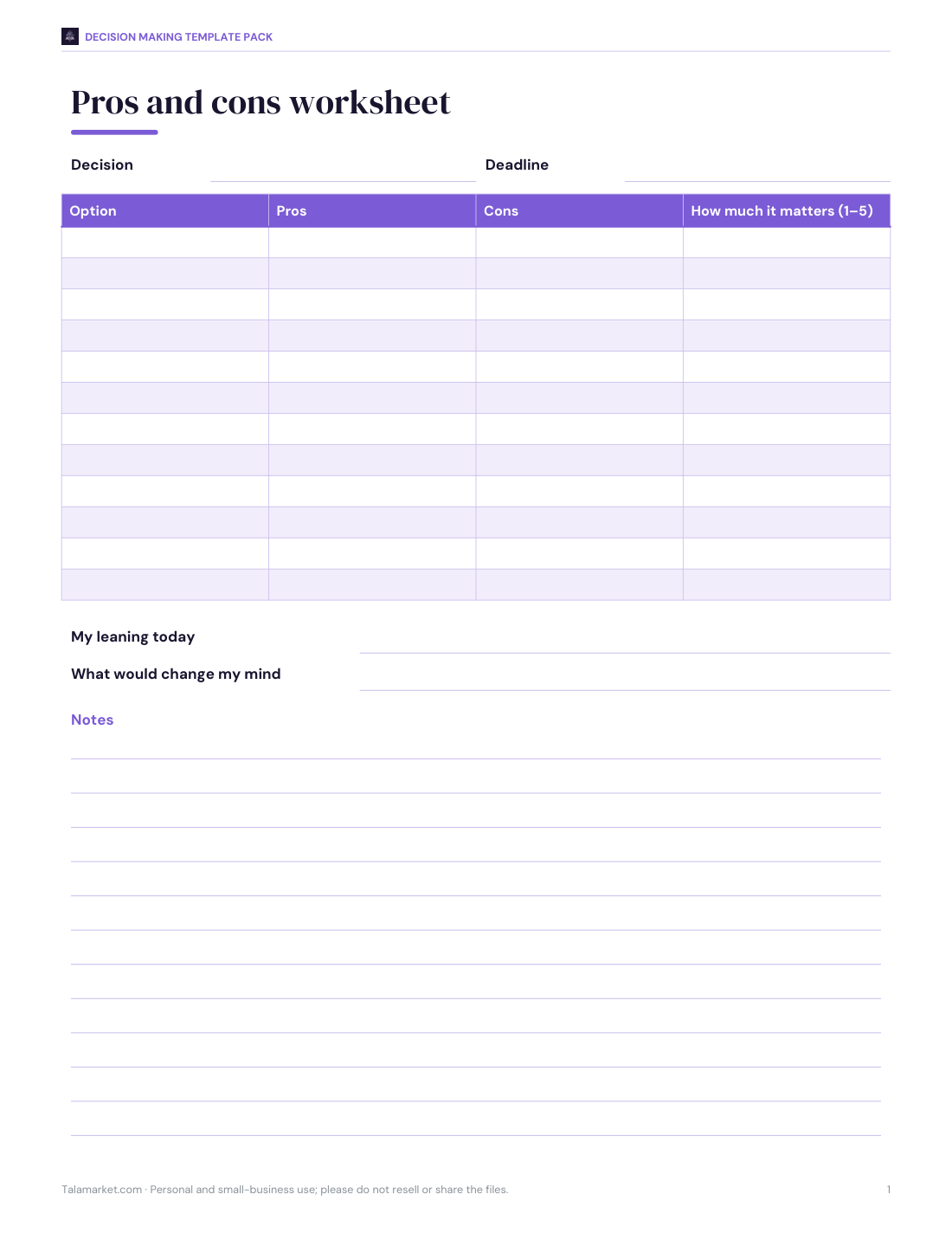
| Pros and cons list | Write advantages and disadvantages of each option | Two options, quick clarity |
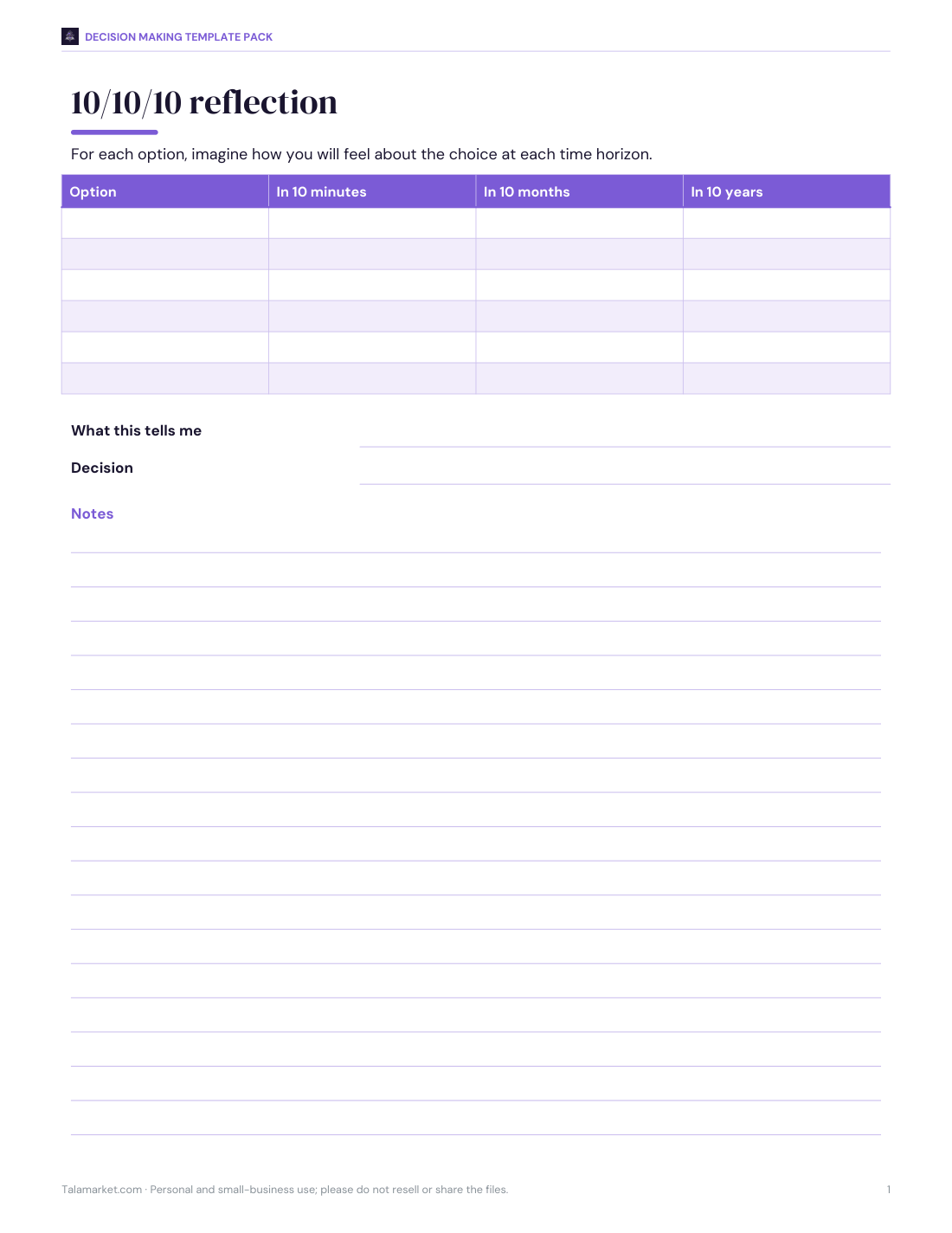
| 10/10/10 | How will I feel about this in 10 minutes, 10 months, 10 years? | Emotional decisions |
| Eliminate the must-fails | Cross out any option that fails an essential requirement | Many options |
| Sleep on it | Decide tomorrow, after writing down your leaning today | Big but not urgent decisions |
| Random pick | Let chance choose between equally good options | Small or equal choices |
Choosing good criteria
- Make each criterion about one thing: “cost” and “quality” separately, not “value”.
- Avoid double counting — “salary” and “total pay” measure the same thing twice.
- Include what you would lose as well as what you would gain, such as time with family or security.
- Phrase criteria so that a higher score is always better: score “short commute”, not “commute length”.
- Ask the other people affected what matters to them; a shared matrix is a good way to decide together.
Common decision traps
| Trap | What it looks like | Counter-move |
|---|---|---|
| Status quo bias | Preferring the current option because change feels risky | Score “stay as is” honestly like any other option |
| Sunk cost | Continuing because of what you have already spent | Judge only future costs and benefits |
| Anchoring | The first number you hear shapes every comparison | Gather several data points before scoring |
| Analysis paralysis | Endless research on a small or reversible choice | Set a deadline, or let chance pick between close options |
| Confirmation bias | Looking only for reasons your favourite is best | Write down the strongest argument against it |
Knowing these patterns doesn’t make you immune, but naming them makes them easier to spot, especially when you revisit your decision journal later.
Why let chance decide?
For small decisions — where to eat, which film to watch — the time spent deciding often costs more than a “wrong” choice. A random pick ends the debate. Some people also use a coin flip as a test: if you feel disappointed at the result, you have learned what you actually wanted. The weighted random pick gives better-scoring options a proportionally higher chance.
What’s in the template pack
- Excel decision matrix with weights and automatic weighted totals
- Printable pros and cons worksheet
- 10/10/10 reflection worksheet
- Decision checklist
- Decision journal to review choices later
The pack is a one-time download for personal and small-business use.
Privacy
Your options and scores stay in your browser.
Frequently asked questions
What is a decision matrix?
A table that scores options against weighted criteria to rank them.
How many criteria should I use?
Usually 3 to 7 — enough to capture what matters without diluting it.
What does the sensitivity check do?
It changes each weight by one point and shows whether the winner would change.
What if two options tie?
Decide on factors the matrix doesn’t capture, or add a missing criterion.
Is the random pick truly random?
It uses your browser’s random number generator; it’s fine for everyday choices.
Is my data saved?
No. It stays in your browser.
Can I use it for group decisions?
Yes — agree on the criteria and weights together first, then score each option as a group or average individual scores.
How do I choose weights?
Ask how much you would give up on one criterion to gain on another; the essential ones get 8–10, the nice-to-haves 1–3.